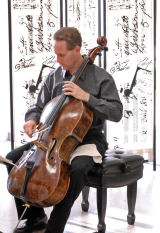
I head out tomorrow (Saturday) for the first of my cross-country roundtrips. Me, my cello, and my trusty Prius V. My wife Jennifer will join me for my second trip in April, but this one is a solo affair. Thank goodness for a comfortable car, a ton of podcasts, and what looks to be good weather for the first legs of my trip. The itinerary over the next month:
Travel to Denver – concerts in Denver & Colorado Springs with pianist/composer Ketty Nez (and hanging out with my sister and her family)
Travel to Las Vegas – masterclass at the Nevada School of the Arts (and reconnecting with an old friend, Raja Rahman, who leads the school)
Travel to Beverly Hills – a week of premiere performances of my colleague, Xiang Gao's, musical, Shanghai Sonatas, at the Wallis Annenberg Center
Travel to Tucson, AZ – masterclass at University of Arizona, recital at nearby venue with pianist Mark Livshits
Travel to Las Cruces, NM – masterclass and recital (again with Mark) at New Mexico State University (and spending time with my mom: Las Cruces is my hometown!)
Travel to Houston – rehearsals for recitals in April and May with pianist Neal Kurz (and an Astros game – anyone who knows me is not surprised by this)
Travel back home – only to turn back around a few days later to head to the west coast again
This is insane, I know, and I am probably as curious as you are (assuming you haven't already clicked on to a new Tik Tok that your friend sent you in a text) as to how I'll fare spending that much time in a car. But I am excited for the variety of experiences, seeing a lot of friends and family along the way, and actually the driving itself. Something about being on the open road (open road not being Interstate 95 here on the east coast) is sort of alluring to me.
The variety of musical experience is fun for me, and I will be reflecting on these different experiences as the happen, but I thought I'd reflect on the concert with Ketty, as well as a concert I was just part of this week at my home base of the University of Delaware. Both of these concerts offer a rare treat: sharing the stage with the composer who wrote the piece I'm playing.
The first was this past Wednesday, on stage as part of a concert in honor of Jennifer Margaret Barker, our celebrated Composition faculty, who will be retiring at the end of the semester. Colleagues put together a concert of her works, and I very much enjoyed playing in a small ensemble presenting a gorgeous setting of two poems by Stephen Dunn. Faculty schedules being what they are, we had scant rehearsal for the work, so Jenny kindly agreed to conduct, to help the ensemble process along rapidly. Nobody would know the score better than the person who wrote it, so having that wealth of knowledge leading the group was a source both of great comfort and excitement.
The concerts next week (one a house concert in Denver, and the other a performance at Colorado College – livestream link here if you're interested and available at 7:30 PM Mountain Standard Time on Thursday, March 9), are bookended by older pieces: the Janáček Pohadka (which I waxed quasi-poetically about in my previous post) and the unfortunately (to me, at least) lesser-played Sonata by Ernö Dohnanyi. You don't need to hear any more about Janáček from me, but I find the music of Dohnanyi to be fun, clever, and often (I believe this is the musicological term) swashbuckling, sounding like a cinematic adventure on the high seas. His Cello Sonata is rather "Brahmsian" in its writing, not uncommon for a lot of composers of the era (why not copy from the best?). Dohnanyi, a Hungarian, spent a lot of time trying to "Germanify" himself, going so far as to call himself Ernst von Dohnanyi in lieu of his actual name, Ernö.
The rest of the program is wonderfully all by living composers from around the globe. There are short works (both beautiful and reflective) by Ukaranian composer Bohdana Frolyak and Hungarian composer (and friend of my friend Ketty), Gyula Bánkövi, a wonderfully written and characterful Nigun & Hora by our host at Colorado College, the Israeli-American composer Ofer Ben-Amots, and Ketty's own 5 moments, a work she wrote for the two of us and that we have recorded as part of a larger compendium of her duo works.
Getting to play Ketty's own music with her at the piano has been a thrill, and she so deftly explains the sounds and characters that she is hearing in her mind's ear. It's also a bit of a challenge; since this is music she wrote (in this case, settings of Macedonian folk songs that Béla Bartók had notated but never set to his own music), it's also music she is free to change as she hears things that she either doesn't like or ended up sounding different than her imagination had told her. So, that meant a lot of scratching out of old music and scribbling in new music. I play off an iPad for performances, which has made that process a lot less messy looking than it would be on paper and pencil, at least.
The fun of working with these composers in this way highlights the joy of playing music by living composers in general. One still gets to put his/her/their individual voice into a performance of the music, but there is a whole lot less guesswork, as the composer is just a text or email away, or in my case, in the room with me.
The breadth of expression and stylistic output between living composers is also a treat. In Jenny's Two Poems, I was treated to a beautiful soaring melody like this:
And in the third of Ketty's 5 moments, there is the swirling complexity of a (still soaring, albeit with lots faster notes) melody over shifting ostinato figures in the piano (be warned, this page might make your head hurt):
Fellow cellists, feel free to offer fingerings that you think work better!
My other performances in March, and then again in April, have a higher percentage of performances by dead white guys (and a dead white girl or two, as well), with the exception of a solo program I'm playing later, in Washington and Monata, that is made up entirely of living American composers. But what I find is that this luxury of getting to interface (and even perform) with composers in their own music, is that I gain insight that helps unlock the kind of questions I might have about the music where I don't have that luxury. Pretty cool way to expand one's horizons.
Okay, gotta go pack – lots of clothes, shoes, etc. to figure out for being away for a month!
I plan on reflecting on the performances and travel that I will be doing during my sabbatical semester from the University of Delaware. I have two cross-country roundtrip drives planned, starting in March and stretching through early May, with a variety of performance and masterclass activity, mostly in the western United States. Assuming I survive the U.S. Interstate system, and whatever understandable ire that builds up at home as I am away for large swaths of time, I will share my musical travelogue from time to time.
The first two weeks of my sabbatical were rather eventful, but not in the way that I would have hoped. I ended up with my very first case of COVID, and it knocked me out. But last week was finally COVID-free, and it started with the first concert of my sabbatical semester at Susquehanna University with a wonderful pianist and old friend, Naomi Niskala. In terms of my other performances that are coming up over the next two months, this one was a little bit of a one-off, given that it was just one concert and then a quick return home. But the opportunity to play with Naomi and in such a beautiful hall was something I didn't want to pass up. And if you get the chance to hear Naomi play, take it – especially in her duo with the fabulous cellist An-Lin Bardin. They are doing compelling programs of important work in exploring and celebrating works that express varying modes of identity.
Stratansky Hall at Susquehanna University, Selinsgrove, PA
This concert presented some of the music I will be playing at other venues, with one exception being my lone performance of the first Beethoven Sonata on this program (man what a piece! Beethoven wrote it partially to show himself off to Friedrich Wilhelm II, the Prussian leader of the time, in concerts in Berlin, and if this music didn’t impress, there was something very wrong with FWII). The other music: Pohadka by Leoš Janáček, Ballade by Minna Keal, the Three Romances of Clara Schumann (in a lovely transcription from the violin original by Yuri Leonovich), and Mother and Child by William Grant Still (another fine transcription, this one by Tim Holley). Nice program, and despite being more exhausted than usual at the end of it (COVID hangover, for sure), it was a blast.
After the concert (very sparsely attended, but seemingly a very appreciative audience, at least), a young Susquehanna student visited with us backstage, and even asked for my autograph! (this is indeed the closest I will ever get to my fantasy of being a big league shortstop) She then asked me what my favorite piece on the program was. I responded that I was trained to say that whatever piece I happened to be playing at the moment was my favorite piece, but I decided to share a little secret with her, about my specific love for the first work on the program, the Pohadka. It’s a piece that I first heard as an undergrad, when one of our doctoral students played it on a recital. I was intrigued with this composer I didn’t know well yet, but my infatuation with this piece and Janáček in general came a few years later, in New York.
While I was a grad student at Stony Brook University on Long Island, I made every effort I could, within the financial limitations of a starving student, to get in to the city to watch concerts. This was particularly the case when two of my musical heroes, Joel Krosnick (then the longtime cellist of the Juilliard String Quartet) and Gilbert Kalish (legendary pianist, and an occasional chamber music coach of mine at Stony Brook, a person who very much shaped my musical sensibility) would give one of their Sunday events of two concerts in Miller Theater at Columbia University. During one of these Sundays, in April of 1992, they did a series of works as part of a Highlights of the 20th Century theme (here’s The NY Times review of this memorable day), and this little Janaček nugget was on one of the concerts. Joel & Gil were always must watch performers, and I have fond memories of many performances, but this specific one stopped me in my tracks. I was struck with all the elements of Janáček’s unique musical language that I now love so dearly, laid out with musical clarity and technical brilliance by these two remarkable artists.
When I got the chance to put the piece on one of my DMA programs, I leapt at it. (For those who don’t know the lingo, DMA stands for Doctor of Musical Arts, though other definitions sometimes get used, mostly by non-doctorate musician friends who like to rib me: “Doesn’t Mean Anything”, “Didn’t Make it as an Artist”, etc.) Now I was getting the benefit of learning the work from my teacher, Tim Eddy, who to this day remains another of my great musical heroes, and someone from whom I still draw great inspiration. A few years later than all of this, I was excited to start my New York recital debut program with the Janček, with my old friend and collaborator Jonathan Faiman, at Carnegie Hall’s Weill Recital Hall (nervous, too, as I could still remember Joel & Gil’s performance of it seven and a half years earlier, uptown about 50 blocks, and couldn’t help but fret about some comparison of the two performances). I’ve revisited the piece a few times since, most recently in a really fun collaboration with Kuang-Hao Huang, who visited for a performance at the University of Delaware, and now during this spring.
So, why do I love this piece and this composer so much? There is something in Janáček’s musical language that is simple and honest, maybe even innocent. What I find truly remarkable about the composer’s craft is that while remaining true to this simplicity, he creates musical moments that sound far from simple, and electric in their excitement. Unlike many of his contemporaries in the early 20th century, he continued to write music that was tonal in its harmonic underpinnings, and even what people might refer to as tuneful. The opening of the Pohadka (which is a 3-movement piece based on a Russian Fairy Tale - innocent simplicity even in its inspiration) shows all of this: the austerity of two notes that suspend as if in mid air, giving way to a gentle spinning of simple scale fragments, before the cello enters with a staggered rhythmic utterance (one that becomes an important motive throughout the piece). Even for non music readers, you can see a gentle and simple spinning out of different strands of music.
Cellist’s aside: as much as I love this piece and the chance to play it. I do not love this first entrance, which is a chord in a very challenging key for us (Gb Major), requiring a hand position and finger spacing that is far from natural. My friends in the Calidore String Quartet like to joke with their cellist, Estelle Choi, that when she has to play fingerings like this, she looks like she’s making gang signs. Here’s a screenshot from the livestream of what my hand looks like in that first chord:
I was wearing a mask as I was coming out of COVID, but I can assure you this was the look on my face:
😬
The movement used some of these simple (cello fingering aside) fragments as increasingly agitated and quirky rhythmic outbursts that become foundational to the music as ostinati (an ostinato being a repetitive melodic/rhythmic fragment, usually used as an accompaniment to something more melodic). See here the end of the opening section of the first movement in the cello, a simple minor third (the same interval that started the whole piece with those two notes in the piano) growling in accompaniment of an even further fragmented scale pattern in the piano:
The very next section, one of the most beautiful and soaring, and simple, melodies we cellists get to play, is now supported by that same ostinato in the piano, certainly less angry than it was in the cello, but still with some urgency underneath the gorgeous cello line:
This isn’t an undergraduate term paper, so I’m not going to go on with this sort-of roadmap analysis of the music, but I did want to show the simple genius of Janáček’s craftsmanship, taking the most mundane musical elements, chopping them up, and making the richest of tapestries of them. All good composers do this in their own way, but Janáček’s individual language is unlike any other that I know. I find that non-musicians often don’t know much about him, and when he is discussed more broadly, he often gets overshadowed by the composers he gets lumped in with, Béla Bartók and Zoltán Kodály (those guys are astounding and important composers, of course, but I find Janáček always ends up not recognized as much as he deserves when he’s thrust into their shadow)
I get a couple more goes of Pohadka this spring (which is good, because it’s pretty hard, and I’m never actually satisfied with how I play it – thanks Joel & Gil, for setting such a high damn bar!), in a couple of recitals in Colorado next month with the incredible Ketty Nez (including a March 9 concert at Colorado College). In the meantime, if you somehow are still reading this and haven’t drifted on to something more interesting and compelling on Twitter or something, I urge you to explore Janáček’s music in general: his Sinfonietta for (very large) Orchestra is a landmark work, as is his opera The Cunning Little Vixen, and his two string quartets are beautiful, poignant, and utterly quirky (might I suggest my pet recording of those pieces, with the always wonderful Hagen String Quartet).
And I’ll see you all from the road when I head truly west for a bunch more concerts and revisiting of old friends: both my fellow performers and the composers we’re playing.
As I write this, I am at 28,000 feet or so somewhere over the middle of the United States. I’m on my way to visit my hometown, Las Cruces, New Mexico. It’ll be a great chance to see my mom for a couple of days and eat some outstanding Mexican food, but the reason for the trip is more bittersweet, to celebrate and say farewell to one of my most important mentors, Marianna Gabbi. Marianna passed away in September, at the age of 90, after a massive heart attack. 90 is pretty good age and evidence of a life well-lived, for sure, but her passing still stuns and saddens me to my core. I really sort of expected Marianna to live forever, considering the amount of life she had in her and how she shared it with all of us who knew her.
Marianna Gabbi was the conductor of the Las Cruces Symphony, a “town and gown” orchestra (meaning that it included the university music students as well as musicians from the outside community), as I was growing up. Even before I joined the orchestra in my sophomore year of high school, I knew her and knew how she struck fear into the hearts of local musicians, young and old. An Italian American from South Philadelphia, she was the fierce embodiment of both of those traditions – a pretty intimidating mix for mild mannered folks in southern New Mexico. She had studied internationally and in Philly growing up as a promising young violinist, and ended up studying conducting, receiving her doctorate at the University of North Texas before coming to Las Cruces in 1975. Over her years there (she retired from the orchestra in the 90s), she brought a standard of musical excellence and sophistication that had been in short supply before. The orchestra routinely played above its head to give exciting and meaningful performances, and with the help of a generous and connected patron, the orchestra was able to host world-class guest artists.
I entered her orbit right around the start of high school. I had become pretty serious about the cello, and was brought to her attention as someone to watch. As she did with my other serious musician friends of mine, she swooped right in, insisting that I come to her house to read string quartets with her. These weekend afternoon sessions, my first real taste of high-level chamber music, shaped my future as much as anything – through her unique blend of encouragement and berating, she taught us how to listen, how to stand up and express ourselves, and how to connect with this music that meant so much to her (and as a result, ended up meaning so much to us). This put me and my friends on a path to delve even deeper, and as time went on, we would get together without her to slog through Mozart, Beethoven, Brahms, Dvorak – repertoire we might not have any right to play at that point, but that we jumped into with the abandonment Marianna had taught us. I credit her with whatever success I’ve enjoyed as a professional chamber musician, and I work to pay that forward to my own students, and anyone else I can get to listen to me.
I also learned a lot from her in her role as conductor of the LCSO. The passion she brought to the podium was palpable, and the fear she struck in the hearts of the orchestra members was, too. But even as musicians would occasionally feel under attack, for sloppy playing, a missed entrance, or coming late to rehearsal because they were coming from, as she put it, “that God-damned Marching Band”, they kept coming back year after year. Maybe part of it was to see what new Italian curse words they’d learn (our favorite was “Porco Zio!”, essentially “My uncle is a pig!”, and a way of almost sounding blasphemous by not quite shouting “Porco Dio”, essentially, well, you can guess). Maybe part of it was to hear her impressively rattle off solfege syllables faster than a speeding train when singing through something to express an idea to the orchestra. But I think we all came back every week because we knew that this was something truly special, making music for and with this force of nature, and we knew that she, deep down, knew how special this was as well, and loved all of us for it.
I grew up in a very stable, happy household, loved and cared for by my mother and father, but Marianna was a bit like a second mom. I wasn’t alone – for some of my friends, who had a far less favorable home life, she was a lifeline, and cared for these people as if they were her own children. I’m pretty sure her wonderful daughter Paola (Marianna’s only child, a nurse and still-performing violinist herself) feels that she has a lot of siblings.
I will always hold close to my heart a moment during my senior year of high school, during the post-concert hubbub of an LCSO concert one Sunday afternoon. My older sister, who had played oboe in the orchestra before going off to college, came to this concert, which was a remarkable occasion; just a few months prior, she had suffered a very serious stroke (at age 19) and underwent a few serious and life-threatening surgeries. The experience left her working through relearning how to speak and use half her body, and she was as frail and fragile as I’ve ever seen a human being. Marianna, who had not seen my sister for a couple of years, and did not have the close type of relationship with her that she did with me, noticed her in the hallway after this concert. Amidst all of the well-wishers offering congratulations and conversation, Marianna dropped everything and ran over to my sister, hugging her and speaking to her as if she were her own daughter for whom she was so concerned, and so delighted to see getting better. If you were ever part of Dr. Gabbi’s world, you were part of her family.
I am so very thankful that, last year, in what ended up being her final season conducting a new orchestra (the New Horizons Symphony), I was able to be in Las Cruces to play the Elgar Concerto under her baton (I had played it with her as a concerto competition winner decades before). I’ve played with more professional ensembles before, and while the performance wasn’t perfect, it sort of was. Even at 89 and a little more tired than she used to be, Marianna was still pleading with and cajoling the orchestra to make great music, and they did, and I got to be along for the ride one last time.
On stage last night, introducing a recital encore by Nadia Boulanger to honor my wonderful University of Delaware colleague, Julie Nishimura (who is retiring at the end of this academic year), I mentioned that I was blessed to have so many remarkable women in my life: my mom and sister (who is doing just great now, with two kids of her own), my wife and daughters, and countless inspiring colleagues and students. Without diminishing any of them, Marianna remains at the top of that list for what she has meant to me. So, maybe she is living forever after all.
As I approach the 6th and final official installment of my Bach in Wilmington series, this coming Saturday, I wanted to reflect what this has all meant to me. While the crowds of people at the performances haven't been huge, I feel a much greater connection, understanding, and true appreciation for my fellow "Wilmingtonians" from different parts of the city. Having the opportunity to listen to these folks in the interviews I conducted, seeing the city through their eyes, I feel optimistic about the future, even acknowledging the significant challenges in the present.
But I also realize that this optimistic future for my city will not at all be realized by a middle-aged, middle-class white guy going and playing the cello in a variety of churches and community centers. The future has to be shaped by a lot of people who not only care, but are committed to continue showing up and listening. In promoting my performances, I've met a few times with a group of Interfaith leaders in the city. Seeing their passion for making Wilmington a better place, and their willingness to go into and stay in the neighborhoods to learn how best to be of help, has given me fuel to continue my project in whatever ways I can. I do believe in the community-healing potential of music (both the old music of Bach and brand new music like Mazz and Alisa are writing), and want to continue to be out there, listening and playing. Not sure yet where that will take me - whether it's continuing and expanding my current series or forging something new - but I know that, especially in today's social and political climate, I personally can't only retreat back to the practice room and traditional concert hall.
So, more on those plans as they develop. I wanted to draw your attention to a performance coming up at the Music School of Delaware in Wilmington, presenting the Preludes of all six of the suites, alongside the Swift Rose companions, as part of the school's Adult Cello Festival - should be a nice retrospective of the project as a whole. There will also be a short documentary film coming out soon, created by the wonderful and insightful Jason Chesnut of Ankos Films, and I am in preliminary discussions of some kind of recording, web series, or some combination thereof. In the meantime, I'll focus on the performance coming up on Saturday, July 21 at 5:00 PM, at Temple United Church in West Center City.
West Center City is a part of Wilmington that is a bit more troubled than most (though not all). Whatever economic advancement Wilmington has seen hasn't made it to this part of town, and the economic and social injustice here has too often led to violent desperation; gun violence, while down this year compared to recent years, is a constant fear and persistent reality, especially as drug dealers swoop in from out of town in an easy exit off Interstate 95. There is a long history behind these challenges: after the assassination of Dr. King in April of 1968, and the ensuing protests and riots, the National Guard was called into Wilmington, and West Center City was ground zero for a nine-month occupation, the longest in America since the Civil War. While heroic efforts by great people have continued for 50 years, this part of the city continues to struggle to get back above water, certainly compared to other parts of town. (just a half mile down the road, the recently renovated and rebuilt Riverfront, looks like an entirely different, and much more affluent, universe)
A view of 8th & Madison Streets, 1968.
But the heroic efforts to lift up this part of town continue, and one the heroes is the Pastor at this little Temple United Church, John Graham. Pastor Graham founded the church in 1971, and has been working tirelessly to build and rebuild the spirit of West Center City. He is a strongly devout man with a gentle demeanor but strong constitution, and a laugh that is as infectious as any I know. Here's the story of how I ended up working with him and Temple United (from the program notes for Saturday's program):
I first visited this place back in the winter of this year, when I accompanied my neighbor and good friend, Mark Perri, to work on interior storm windows and witness the Windows of Hopeproject started by the Wilmington in Transition organization. Some upstairs rooms in the church were used as workshops for creating these windows to help residents in the city, particularly those of less advantage, save on energy bills without having to spend so much money to do so. This project speaks to the practical, but powerful, on-the-ground work being done in this city to help raise people up. Needless to say, my first experience with Temple was a warm one.
Knowing about my Bach in Wilmington project, Mark thought the church, and its caring and charismatic minister, John Graham, would make for a good prospective partner, and I was eager to make it happen. In meeting with Pastor Graham, I was struck by his gentleness and warmth, so I was a little disappointed when he felt the Hicks Anderson Community Center would be a better place for my performance to honor West Center City. Hicks is a real beacon in this part of Wilmington, and I was happy to pursue it, but I have to admit being a little relieved that, for a variety of reasons, things didn’t work out with them, and I was able to come back to Temple and ask again. It is my great thrill and honor that Pastor Graham was amenable and that we were able to work things out together for this program.
Pastor Graham and his Deacons live their faith through their works. I was honored to follow them into the streets as they sang and offered ministry and support for the folks in the neighborhood. As I offer this final performance of the 6-concert series, Temple United Church embodies the spirit of why I’m doing this: as neighbors, when we talk to each other and, more importantly, listen to each other, we can make our community healthier and more whole. It has been a truly meaningful experience for me to talk to, listen to, and play for my neighbors across Wilmington, and I look forward to deepening the conversations with new friends moving forward.
So, in finishing my project (for now), I hope to see some of the locals this Saturday, and the following Friday. For those reading along out of curiosity about what the heck I've been doing, thanks for keeping up, and I would urge you to do just one thing: be a good neighbor. Make eye contact and say hello to people you meet on the street in your town or city, particularly if they don't look like you, or it's clear they come from a different culture and/or religion. And most importantly, just listen when these folks talk to you; the more we can actually hear each other, the quicker we can get out of the morass that we've gotten ourselves into in this country (and probably other countries, too). I knew, going into this project, that I couldn't solve any of the world's problems, but I'm more convinced than ever that the solutions, while really difficult and generations-long in duration, are achievable. It starts with each of us willing to provide a smile, an open mind, and an attentive ear.
Bach is Back in Wilmington Posted Wed, 13 Jun 2018 01:26:00 +0000 After a month of catching up with the non-Bach parts of my life, I'm back to continue with the Bach in Wilmington project. Next up, this Thursday, June 14 at 11:00 AM, at the Kingswood Community Center, I'm playing as part of their summer camp for kids. Normally, playing solo Bach for kids would seem a like a recipe for early nap time (either for them or me, possibly both), but with recorded interviews interspersing the Suite movements (with voices many of the kids will recognize), and a really awesome new piece by Mazz & Alisa, I'm hopeful I'll keep most people awake. And I believe I will be all that stands between the kids and their lunchtime, so they have no choice but to listen to me.
As I have been doing with the past concerts, I'm sharing my reflections on what makes Kingswood a special place to be playing this music:
I only became aware of Kingswood Community Center recently, when my church, the Unitarian Universalist Society of Mill Creek, had KCC as a recipient of our “share the plate” offerings for a couple months late last year. As part of my project of community building and celebration, I had been hoping to find organizations from different parts of Wilmington, doing different kinds of great work for the city. After a visit of the facilities, and meeting Logan and Shardae, I knew it would be both a great fit for the project, and an honor to talk to and perform for the folks here.
Kingswood was the first place I was able to schedule and conduct audio interviews — you will hear excerpts of these efforts this morning. In getting to speak with Ms. Cookie and Mr. Craig, two rightfully-celebrated members of the staff here, I realized the great humanity that was being spread through this place by the people who work here. From the youngsters here for daycare and summer camps, to the older folks who call this community home, Kingswood truly embodies the loving and nurturing kindness of community.
The most touching symbol of this community, for me, is the mural on the outside wall. The members of KCC were asked who should be painted on to the mural, likely with an assumption that great national and world leaders would be chosen. Instead, there was a groundswell of support for painting members, staff, and “alumni” of this place to be painted on the wall, put up for all to see in eternal celebration. This is my wish for Wilmington , as well — to see and celebrate the goodness and greatness in each other, and to proudly let everyone see it.
The mural on the outside of Kingswood Community. It includes one of the wonderful people I interviewed.
On tap for Thursday are Suites 1 (G Major) and 3 (C Major), in addition to the new piece. This is the 5th of 6 events of my project. The final special concert is Saturday, July 21, 5:00 PM, at Temple United Church (with the Eb Major Suite, one to be determined, and the final new work by Mazz & Alisa), and I will be presenting all six Preludes alongside the six new works, as part of the Music School of Delaware's Adult Cello Festival, Friday, July 27, 7:30 PM.
After that, it's possible Bach will go on the shelf for a little bit, though I'm looking at a potential recording project with it, so I might just get to keep playing this glorious music a while longer.
And stay tuned for a short documentary film about the project, hitting a YouTube channel near you soon!
Bach in Wilmington continues! Old Swedes Church Posted Sat, 05 May 2018 14:36:00 +0000 Today is my third Bach in Wilmington concert in four days, and fourth one overall. Each place has been unique and tremendously fulfilling; the personal interaction with the people at these places and the audiences coming to listen will stick with me forever, and I am really grateful for reconnecting with old friends and making new ones here in the city. I am also exceedingly tired, so if this blog post trails off into a series of incoherent characters, it is quite possible that I simply fell asleep on the keyboard - if so, I suggest you close the browser window and go about your day.
Today's venue (4:00 PM, May 5th) is historic Old Swedes Church in Wilmington. The church was built in 1698 (yes, by Swedes - a huge Swedish tradition in Delaware, which is cool, given my Swedish heritage), and is, as I understand, the longest continually operating church in the United States. It is a venue that is utterly quaint and beautiful in its colonial-era charm.
As I have done with the other venues thus far, I am sharing what I am putting in today's program about "Why Old Swedes?" for this project:
The location of Old Swedes represents, for me, both the greatness and the challenge of Wilmington. On the city’s east side, this church highlights the beauty and tradition of Old Wilmington, but is also a stone’s throw from neighborhoods that face great challenge in terms of social and economic justice and opportunity. As part of this Bach in Wilmington project, and as someone who lives in a neighborhood (The Triangle) that faces far fewer of those challenges, I want to share in conversation of words and music with as many of my extended neighbors as I can - the more the city walls us off from each other, the harder it becomes to truly address those social and economic injustices. So, in addition to the fact that Old Swedes is a beautiful venue, with lovely acoustics, and part of an outstanding Trinity Episcopal Church community (all worthy of celebration and music), I am here to celebrate and share with the folks in the neighborhood.
One of the neighbors, right next door to Old Swedes, is Minister Margaret Guy’s Stop the Violence Prayer Chain Foundation - the office is nestled in a small building right at the edge of the church’s parking area. Margaret and the organization are working both to curb gun violence in Wilmington, and to serve people who are and have been affected by that violence. In addition to public advocacy work, the Foundation spends a lot of time serving a group of children, whose lives have been touched by these challenges. It is these kids’ voices you will be hearing in conversation with the Bach today. Margaret’s commitment toand love for these young people is inspiring and energizing in a time where so much love is needed. I am honored to have gotten to know her and these kids.
The Suites today are No. 1 in G Major and No. 6 in D Major - I can't think of better music to celebrate the innocence and joy of youth than these two suites! And, of course, there will be a new work by Mazz & Alisa, in honor of Margaret and the kids, and in response to the 1st Suite.
After today, there will be a little bit of time before the next Bach in Wilmington performance (despite a couple of more traditional Bach concerts, including next Saturday at the 2nd Annual Wilmington Bach Festival - suites 2, 5, and 6). The next venue will be June 14th at the Kingswood Community Center, and then one on July (date and time still being ironed out) at Temple United Church in West Center City in Wilmington. I'll present a concert of the six Preludes and the six companion pieces by Swift Rose on July 27th (7:30 PM) at the Music School of Delaware, as part of Jennifer Stomberg's Adult Cello Festival.
Made it to the end of the blog post without falling asleep and drooling on the keyboard - major win!
My project continues (even though my sleep, as I work through the project, has largely ceased) later today with a performance at the Achievement Center, run by the Wilmington HOPE Commission. While I'm excited about each one of my community partners, this one has really touched me, as I have been able to spend time talking to men recently released from incarceration in Delaware, who are working through the Achievement Center to re-enter to world and its challenges (challenges are particularly great for the formerly incarcerated). It has been a transformational experience for me. This is the narrative I am sharing in today's program:
I was first made aware of the Achievement Center when the HOPE Commission and its former Executive Director, Charles Madden, were being honored with the ACLU of Delaware’s Kandler Award a couple years ago. The presentation of that award highlighted the transformative work being done at this wonderful place, helping individuals recently released from incarceration build better lives, find work, and re-enter the world with grace and dignity.
I was thankful when Tamera Fair, the wonderful current HOPE Commission ED, and Corie Priest, the infectiously positive In-Reach Coordinator here, seemed interested in this project and partnering with me. I couldn’t think of an organization that spoke to the promise and challenge of Wilmington better than this one. In the course of speaking with a number of the guys here, people who either work for the Achievement Center or who are served by it, I was struck, even more than I expected to be, by the candor, thoughtfulness, and humanity these men showed me. Life, and Wilmington, has often not been kind or fair to them, but with the help of the Achievement Center, they are carrying themselves through their lives with a clearheaded purpose and hopeful vision.
As you will hear in the recordings during this performance, I spoke with a handful of remarkable men, any one of which could have provided enough insight to individually fill this program. I am a richer person for having spent time here, and offer my heartfelt thanks to the HOPE Commission for tirelessly working to bend that arc of the moral universe toward justice.
The Bach Suites on the docket for today are the 2nd in d minor (reflecting the past and current struggle and sadness, but resolve, of these men I spoke with) and the 3rd in C Major (a work of pride, strength, and hope, things I saw in abundance there). I will also premiere SwiftRose's new work for this place, In the End We All Just Dance it Out.
Bach in Wilmington Continues - St. Stephen’s Lutheran Church Posted Tue, 01 May 2018 18:56:00 +0000 Having managed to survive both the first Bach in Wilmington performance (Hanover Presbyterian Church - wonderful people and place!), and the complete Bach Suites Cycle at the University of Delaware (also wonderful people and place, and they pay me a salary!), I’m moving on to an intense week of activities. First stop: St. Stephen’s Lutheran church in the Trolley Square section of the city.
Here’s what I’ve written about these good folks, for the program tomorrow, May 2, 7:30 PM:
To be honest, I had not known much about St. Stephen’s until recently, and the idea of a church in a more “upscale” part of town like Trolley Square didn’t seem like the right fit for my project, where I was hoping to delve into less-celebrated parts of Wilmington. But then I got to know Pastor Jason Churchill through mutual friends in my neighborhood, and was struck by his broad and warm sense of humanity. As I learned more about his vision for St. Stephen’s, and what the church was already doing for the community at large, I realized I was mistaken in my original read of the potential collaboration. Jason was an early advocate of this Bach Project, and was very interested in involving the people of the Food Pantry. I am so glad that we kept working to make a performance here a reality.
The people at the Food Pantry here, staff, volunteers, and clients, are treasures of our community. As one of the clients said to me, and as you’ll hear in one of the recorded interview segments, “They got a sign on top that say ‘feed the sheep’, and that’s exactly what they do”. In a time where the world seems to be drawing more and more into its individual corners, the spirit of community and love I saw here on Friday mornings and Wednesday evenings was spiritually nourishing.
Wilmington is a place that has a great many problems, but just as many points of promise. The work that St. Stephen’s does, through its Food Pantry and its expanding ministry to the community, is worthy of admiration and celebration.
So, to honor the challenges and hardship of the folks at the Food Pantry, as well as their strength, resolve, and optimism, I’m pairing the 5th Suite in c minor with the 4th Suite in Eb Major. And I will present the new SwiftRose work in response to the 5th Suite,“I don’t want to break my own heart being sad when I know I can find a way to fix it”.
My colleague, the videographer Jason Chesnut of Ankos Films, will be there to start his documentary of the project, so hopefully soon, this will get shared with more folks than are just in attendance.
Okay, of to go practice trying to play in tune in Eb Major!
Bach in Wilmington - First Stop: Hanover Presbyterian Posted Sat, 21 Apr 2018 04:01:00 +0000 Well, at this point, since I'm nearly out of time, I'm hoping that I know my notes well enough to present the Six Suites of J.S. Bach - I present the cycle over two nights at the University of Delaware this coming week (April 24 and 25, both at 8:00 - if you can't be there in person, but want to check it out via live stream, feel free to visit our page at UD)
But before that, I am excited to get started with my Bach in Wilmington series, which I've written about on the blog already. The first concert is at Hanover Presbyterian Church, just down the street from where I live, this Sunday, April 22, at 4:00 PM. On the program are the d minor and Eb Major Suites by Bach, as well as the premiere of the new work by Mazz Swift, Flow, written specifically for the people at Hanover.
I thought I'd share what I'm putting on the program about this venue, and the wonderful people I've met there:
As I begin my series of Bach in Wilmington concerts, I want to make sure to note what makes each venue special to me and to the city. Hanover Presbyterian is a church that I see often, living just down the street. I had performed at the church a couple of times, but what really drew my attention to the place was a large sign on the side of the building, proclaiming the welcome and acceptance of immigrants and refugees; in a time in our country that is frightening for both of these constituencies, I continue to be moved by Hanover’s commitment to serving them.
Already knowing Twyla Evitts, Hanover’s outstanding Minister of Music, I knew of the strong musical life here. And as I got to know Pastor Andy Jacob, and we talked about and planned for today’s performance, I realized that this church was also much more than just the heroic efforts with immigrants and refugees. In addition to being a diverse and welcoming place of worship, Hanover is a food pantry, a clothes closet, and a hub of goodwill for this part of the city.
In speaking with members of the church, and volunteers who give their love and time to the place, I felt the importance and vibrancy of this church home. You will hear their voices throughout the performance, in dialogue with the music of J.S. Bach and Mazz Swift, and these voices, young and not so young, are the voices of Wilmington - diverse, proud, and hopeful, even in weariness. It’s my hope that the conversation of words and music will leave you as inspired by this place as I am.
If you happen to be in Wilmington on Sunday and want to come hear the voices of Hanover and this great music in dialogue with one another, please stop by. And there will be more to share in the coming weeks, too - stay tuned!
Now it's even better to be Bach in Wilmington! Posted Thu, 11 Jan 2018 00:05:00 +0000 I have been heartened by the feedback and good vibes I've received from my last blog post about my Bach project. I am very excited about the work, and actually have my first round of recorded interviews tomorrow, at the wonderful Kingswood Community Center. Just today, doing some work (about which I'll blog soon) in Wilmington's West Center City, I met yet another potential partner for my project, so I'll keep you posted about that, too.
Since the "ink wasn't dry" in time for my last post, I didn't include some exciting news, but I now can. As an integral part of my project, and an idea that was a central part of my original plans for it, I am partnering with two phenomenal musicians, who will be composing short companion pieces to each of the Bach Cello Suites, to respond not only to the music by Bach, but also to the various venues and people for whom I will be playing. I could not ask for better partners in this venture than violinists Mazz Swift and Alisa Rose, who together formed the Swift Rose Duo. Mazz and Alisa are not just amazingly accomplished and wide-ranging violinists, playing everything from jazz to electroacoustic to, well, everything (they rightly call themselves "genre defying"), they are also fabulous composers, and I am beyond excited to have them writing music for me to play alongside the Bach.
Mazz Swift
Alisa Rose
We've been in discussion for some time about the project, and I'm delighted to have it come to fruition. In addition to providing my Wilmington partners with new music they can absolutely claim as their own, the world will be getting new music that will speak directly to the challenges of, as Mazz and Alisa say, "social awakening, dialogue, and change".
Again, I'll be keeping you updated, but in the meantime, that performance at Hanover Presbyterian Church on April 22nd (4PM) is still my first planned performance, and I now have another one to announce, at the historic Old Swedes Church, on May 5th (exact time still TBD).
It's good to be Bach in Wilmington Posted Sun, 31 Dec 2017 23:14:00 +0000 While I and my family have lived in the state of Delaware since 2004, when I was fortunate to join the faculty at the University of Delaware, we have only lived in the city of Wilmington for the past 5 1/2 years, having moved from the suburbs. My wife and I were excited to take advantage of built-in diversity of the state's largest city (56.5% African American, 29.3% White, 11.5% Hispanic, as of 2015), as we wanted our kids to grow up in a place where not everyone looked like them, or had the same background. We looked forward to living a more vibrantly integrated place. 5 1/2 years later, I remain frustrated that we seem almost as segregated as we were in the suburbs.
Wilmington, like many cities, frankly, effectively walls off its different neighborhoods from one another, not so much with physical barriers more than cultural and economic ones. I am not well-versed enough in sociology to talk at length about this (my son, pursuing political science in college, wrote a very nice recent post about these "walls", which I encourage you to read), but I know enough to know that it's an unfortunate and unhealthy way for a community to exist, and a seemingly insurmountable problem to overcome. So, in our first years here, we have done our best to at least be neighborly on the edges of our walled-off neighborhoods whenever we can, oftentimes only at Halloween, when we'd get to greet neighbors from "across the street" who came trick-or-treating.
Then 2016 happened, and the world at large became even less neighborly (Brexit and the U.S. election, as two examples). It seemed that our culture has moved even more dramatically from neighborhoods to ideological tribes - if you aren't in my tribe, you aren't welcome. (and notice that I'm not taking sides politically - this is a problem across the ideological spectrum) Instead of talking to each other, we talk (or more likely shout) past each other, and we certainly aren't listening to each other. Global tribalism seems to trickle down and make local problems even worse. This dark turn in our culture has been a particularly psychic blow to those of us in the arts, as we thrive on cultures coming together to celebrate what's best about humanity. I have spent the last year and a half chewing on this cultural cognitive dissonance, wondering what, if anything, I could do as a cello player, at least to lend my little voice against the darkness and desperation of our time, and of my city.
I had been thinking, as many cellists do at some point, of doing the Bach Suite "Cycle" - performing all six of J.S. Bach's Suites for Accompanied Cello, seminal works of our literature, in one performance or over a couple of nights. And many cellists have, and continue, to do the cycle, especially in the past year; perhaps my fellow cello players are having a similar reaction as I am, and are turning to music that is pure, and musically/emotionally/physically/spiritually fulfilling. I didn't just want to be yet another cellist playing the suites (though I am doing that, too, over two nights in April), but wasn't sure how to revisit all this music in a new light. As I thought about Bach himself celebrating a variety of cultures in presentations of dance music of different national and cultural origins, I wondered about sharing this music, and my playing, with my "walled-off" neighbors.
But that wasn't enough - just doing this would be me, as a privileged white musician, playing ancient music for an "alternative" audience to assuage my white liberal guilt for not being able to do more. I really want to talk, and listen, to my neighbors; in some miniscule way, maybe that can start to lead us to a healthier culture. So, I've embarked on a "Bach in Wilmington" project that I'm really looking forward to. (though the name isn't great - I'm happy to take suggestions!)
Here's my pitch (that I've been using for grant proposals): I will be performing the suites in various venues in Wilmington. 2-3 Suites will be performed in different venues in the city, and each performance will be introduced and interspersed by audio recordings of interviews I will conduct with constituents/members of these organizations, addressing their hopes, fears, and realities of living in the city. The specific Bach Suites to be performed will be chosen as a response to these interviews and to the physical space of each venue, expanding a sense of “conversation”. I've got verbal agreements with six institutions across Wilmington (with some extra possibilities yet pinned down), from churches that help immigrants and refugees and operate food pantries for folks on the street, to a prison re-entry program, a community center serving a challenged area of town, and some community organizations working to curb gun and gang violence in the city. I'll share these venues as I get dates lined up for the performances (I can announce one so far, at the wonderful Hanover Presbyterian Church on April 22nd), but right now, I'm working not just on getting all the suites back in my fingers for performances this spring, but also on organizing talks with my neighbors to be recorded for playback as part of the performances. It will be an unusual conversation, with their words and my music, but I'm hopeful we'll all be listening to each other in a new way. I really like living in Wilmington, but I think it's currently a place long on potential and short on hope. And I want to celebrate my neighbors, especially those who don't get all that celebrated. By some small measure, I hope this project can make a difference in making the world, or at least my community, just a little bit better. Entering a new year, talking (and listening) to our neighbors more isn't a bad resolution for all of us.
I reached a completely arbitrary milestone today! 200 days in a row meditating at least once a day with the mindfulness app on my iPhone. At the beginning of the year, I clicked on the icon to promise to meditate every day in 2017 (I already had about five or six straight weeks on the app at that point), and haven't lapsed yet. Yeah, I know, big deal.
But I'm coming to the realization that it might actually be a big deal, and I think it's sorta saving my life. No, I haven't been sick, or broke, or facing any particular existential crisis (well, that one is up for debate, given the state of the world and my country). But even though I've been meditating regularly for the past six years or so, this concentrated and unwavering practice feels different. And it's not that I'm just more relaxed and less likely to react rashly to events (though this is definitely true as well); I feel like a different person with a broader and more balanced view of the world and my place in it.
There are many studies extolling the mental and physical health benefits of mindfulness meditation, and while I feel that I am living proof of those studies, there's no need in a blog to regurgitate all of them. And now, whatever you need for meditation can be easily obtained from smartphones (I am a big fan of the Insight Timer app, which I have used since 2011, and there are many other fine products out there), great websites and podcasts like Meditation Oasis, and even in the Meditation For Real Life section of the New York Times ("How to be Mindful while Cooking", "How to be Mindful while Using Facebook", "How to be Mindful while Getting Deluged by Mindfulness Articles in the New York Times"). If I have a main message to you, it's "take advantage of all this stuff and start meditating!"
Many people still think that it's some mystic art form that is either too silly to bother with or too esoteric to ever understand or master. There is a common concern (one that I too used to hold) that it's not worth doing, because one's mind races way too much for meditation to ever be successful - how on earth can I ever get myself to that state of nirvana when I'm worried about my schedule, or can't get that stupid TV jingle out of my head? But it's not at all about reaching that far away state, where all of the world's ills slip away and the heavens sing. It's about being right where you are, allowing those scheduling worries and catchy tunes to come into your head - the trick is saying "oh, hey, there's that jingle" and then letting it go away whenever it goes away. Then something else might come up - "Ack, did I return that email?" - and that too will slip away at some point. Believe it or not, the more you do it, the better you get at just greeting your thoughts and concerns, and then letting them wander right back out of your head. After a while, the time between those visits even gets a little longer and calmer.
Has this turned me into the Dalai Lama? Far from it - I still struggle with angry reactions and over-reactions, and let my mind, and sometimes my mouth and/or Facebook and Twitter feeds, go to dark and unfortunate places. But I'm a lot better at noticing when that's happening, and am even getting okay at heading those unfortunate moments off at the pass. It'll never be perfect, but it's a heck of a lot better - just ask my family.
I've also noticed really nice musical and professional benefits, too. I feel more focused and in command in rehearsals and performance and more able to get to what I think are the most important points in my teaching. Of course, a good bit of this is experience and having learned what doesn't work, but there's more at work than that, including more detailed, more immediate, and more expansive hearing in my own playing and in collaborating with others musically. Pretty good return on investment of 20+ minutes a day of sitting down and noticing my breathing.
This past December, with some trepidation that it might be seen as inappropriate personal overreach, I did a small meditation session with my cello students at the university in Studio Class. I was pleasantly surprised that it seemed to be met not just with approval, but even with some measure of gratitude. One can imagine how different our world might be if more of those in seats of power had taken that time in their formative years to just sit, just breath, just listen. Like with me, it wouldn't solve all the problems, but sure might give a clearer map to get there.
As I move forward into my next 200 days, and hopefully far beyond, I share my tagline from my app: "Through it all, just keep breathing."
Finding Thankfulness Posted Thu, 24 Nov 2016 04:58:00 +0000 Warning: the first two paragraphs of this post are political, strong, and bleak opinions of my own. Please read through to the end, though - it gets better, I think. In a wide variety of ways, I don't feel particularly thankful this Thanksgiving, even though I guess I should. I've had a great professional year, with a European tour, world premiere, successful concerto co-commission, and a nice promotion at the University. But, in addition to my mother-in-law's passing, other extended family turmoil, and a whole host of great musicians, artists, and leaders passing away in 2016, I, like many others, have spent the past two weeks battling the psychological trauma of the results of the U.S. presidential election. The election of Donald Trump has created in me a sense of deep despair for the country I call home and love dearly, with particular despair for those who are disenfranchised or "different" in any way that was ridiculed or vilified by the President-elect. These are certainly feelings held by many of us who did not vote for him, and certainly held by liberals and most in the arts world (dear Reader, I doubt it's any surprise to you that most, though certainly not all, in the creative arts have a liberal bent). I am less sad that Hillary Clinton was not elected (though I personally felt she had the potential to be an outstanding president) than fearful of a person who I feel (as do at least 2 million people more than not, at the time of this post) is not only shockingly unqualified for the office, but is dangerous in his world view and approach to basic human relations. I don't need to list the many hateful, bigoted, xenophobic, or demagogic things this man has said over the last 18 months in running for office (and a few things in the days since) - they're all well documented. Honestly, at this point, I figure my brightest hope is that he'll simply oversee a kleptocracy, using the U.S. Government to increase his business profits - it's likely pretty illegal and highly unethical, but given my greater fears, I'd take it at this point. My larger fear is that this man, seemingly more interested in attention and adulation than anything else, will listen to the most extreme of his advisors, the number of which is already alarming, and a swath of civil liberties will weaken or vanish, particularly for those who don't look like me, a white, straight male. (the celebrations of hate in the days since the election are hugely concerning) And I worry for the world's security - the world has had its share of loud-mouthed demagogues, but I'm not sure we've ever seen one with control of such massive military and economic power as the United States. Having visited Berlin in March and visited the "Topography of Terror" exhibit, chronicling the conditions leading to Hitler's rise and how the years following developed into the unthinkable, I can't help but find eerie parallels between 1933 and 2016. Sounds hyperbolic, I know, but I'm not alone in thinking this; I just hope I'm dead wrong. Unlike many of my friends, I turned off and tuned out social media as much as possible in the past two weeks. I just don't feel compelled to yell into the echo chamber of like-minded friends or exchange self-righteous diatribes with those who disagree with me, some of whom insist we simply calm down and deal with it, since they had to deal with Barack Obama being President for eight years. I don't at all begrudge my friends who are staying engaged in the social media fight, and they are bringing important insights to their discussions; I will most likely return to those battles, but I needed time to set my psyche right. And I'll most certainly be joining whatever fights I can, in whatever ways I am able, against injustice, prejudice, and bullying. I also don't begrudge those who voted for Donald Trump. He spoke successfully to many people fearful of their future, be it economic or security fears, and I respect that, even if I vehemently disagree with the messenger for whom they voted. But for those, who have come forward with hate, bullying, and threats in recent days and months, who voted for him to advance their outmoded and pathetic white male supremacy and xenophobia, I feel more sorry for you that your own world experience and viewpoint is so limited and diseased. Your way of thinking was, is, and will always be wrong, and while you think you can celebrate now, you will lose. I and millions of others will make sure of it. Amidst this despair and fear, though, I have found an even greater hope, in the lives, minds, and spirits of my children and my students. My own kids, despite dealing with their own despair following the election and worrying about being bullied or, worse, their friends - gay, black, undocumented - being harassed beyond measure, have remained engaged with the world, and continue to treat those around them, whoever they are, as human beings worthy of respect and dignity. When I met with my university students for a studio class the day after the election, I looked into the faces of a group of impressive young adults in an exciting but precarious time of their lives - many of them were reeling from the election results for a variety of specific reasons, frightened for their futures, and I imagine one or two of them were fine, maybe even pleased, with the result (I never asked, and I never mentioned the words Trump or Clinton). But what I shared with them that day was a story of having, just that week, played the Nocturne from the Borodin D Major quartet twice, once for my friend Danny's memorial service, and once for a concert in Pennsylvania, where an elderly woman spoke to me afterwards, tears in her eyes, thanking the quartet for allowing her to grieve through the music for her nephew who had tragically lost his life the previous week. It was in these moments that I was reminded what a gift it is to be in the arts, to have the power and responsibility to share and communicate in ways deeper and more profound than most anyone can. No election or leader can change that reality for us, and our place in the world as artists, regardless of final career destinations, is even more important and valuable in troubled, uncertain times. Feel free to take the previous two paragraphs as meaningless platitudinous drivel if you'd prefer (though that makes me sad for you), but in the days since November 8, 2016, that reality has been one of great healing, hope, and thanksgiving for me, and will continue to be, whatever happens in the coming years. I wish you all (in the U.S., at least) a wonderful Thanksgiving holiday.
Transitions Posted Mon, 19 Sep 2016 04:16:00 +0000 As I just finished the first weekend of performances of a new concert season (already three weeks in to the academic year with my students), and to help ring in a newly updated website (now complete with video performances!), it felt right to finally post something new on the blog. It's been a good long while. Sure, some of that is the function of a busy schedule and other necessities and obligations leapfrogging over an unnecessary spewing of ideas, philosophizing, and bad jokes. But a lot of the reason for not writing is, frankly, it's been a tough year. I'm fine: healthy, happy, had some amazing performance experiences this year, and was recently promoted to Full Professor at the University of Delaware (thanks, UD - this means I get to use the stretch limo and finally learn the secret handshake, doesn't it?). My family is doing great, too. But it's been a year (especially a summer) of transitions and farewells, some of them happy and/or expected, some of them painful, all of them forcing a good deal of introspection.
Happy transitions first. My son started college this fall, and we are delighted for a few reasons: 1) he seems to be thriving and enjoying the experience so far, 2) he's close by, so we can see him a little more often, and 3) he's going to my school, and the tuition remission perk is a huge financial benefit to all of us (and a real bang for the buck considering reason #1). We miss having him at home, but that's the inevitable thing about life - people grow older and move on; and I am truly excited to see what the future has in store for him (and for his sisters, though they still have to live with us for a few more years).
Still on the university front, I have the largest cello class I've ever had at my current school, and it's a varied, vibrant, and gifted group of young musicians. They keep me working hard, and not just in figuring out when the heck I'm going to schedule all their lessons - the work I'm honored to do with them also consistently challenges and refreshes my own thoughts about and approaches to playing and expression, and I'm always the better for it.
And the Serafin Quartet welcomed our newest member (and newest colleague at the university, as well), violist Sheila Browne. The process was a little longer and more turbulent than we had hoped (nothing to do with us or Sheila, just the nature of hiring processes), but we couldn't be happier with our new quartet mate, someone who brings so much experience, passion, and fun to our shared existence.
But, as a former Unitarian minister of mine once said, every front has a back. In welcoming these new people, I also bid farewell to others who came before them. Seeing my graduating seniors and graduate students leave every May is bittersweet, though I get to see them go on to exciting new adventures in the next steps of their musical careers and lives, and social media doesn't really let you say goodbye too much, anyway. (at the very least, I will know which cat videos they re-tweet) And in saying hello to Sheila, we also said a Serafin farewell to Esme Allen-Creighton, my wonderful C-string partner in the quartet for four years, and a cherished colleague at the university for five. She has moved on to a new musical chapter of her life, pursuing Music Therapy back home in Canada (a field for which nobody could be better suited to make a huge and wonderful impact), but we will miss her gentle, Canadian ways, and her consistent bemusement of how Americans pronounce words.
The two transitions that have been harder to manage are the permanent ones. We lost my mother-in-law this July, five years after a devastating fall left her paralyzed. She fought valiantly, working to make improvements to mobility, but in the end, the damage was too much to overcome. Her husband, my step-father-in-law, was a tremendously loving and attentive caregiver for that entire time. While I know she is at peace and he is able to get some rest now, I will so miss the caring and generous soul she was. I was a lucky son-in-law.
The biggest hit, though, is the recent loss of my friend, a great father, husband, and invaluable member of the arts community here in Delaware, Danny Peak. Danny, only 59 years old, was on his daily run in Wilmington, a path he ran all the time, when something caused him to fall into traffic, where he was hit by a car. His wife, another dear friend and longtime collaborator, Julie Nishimura, could use everyone's loving well wishes, as could their 15-year-old daughter. Danny was always a ray of light in my existence, and seeing him always lifted my spirits, be it over a glass of wine after a concert, talking about running, or collaborating on an exciting new project. His love of theater and long line of acting students, and his tireless advocacy for the arts in education, make his death a real public loss, and his life will be rightfully celebrated. The personal, private loss will be a void that will never really be filled.
If you're still with me here, and haven't given in to pouring a large glass of something to forget my troubles, good for you! Maybe you've long realized the eternal truth that is made clearer and clearer to me each day. Change happens, constantly and consistently, whether we want it or not. And that's a great thing, even if the change seems bad instead of good. These transitions, even the ones I never wanted to have happen, allow new ways of growing into life more fully and presently, thankful for what I've had even if I don't have it anymore. Especially if I don't have it anymore.
So I enter this new school year/concert season with open eyes, ready (or more likely not) for whatever change comes my way. I hope the same for you. Okay, go back to pouring that glass of something to forget my troubles.
Ten Years Ago Tonight Posted Sun, 11 Sep 2016 18:02:00 +0000 NOTE: I wrote this post 5 years ago, a few days after the 10th anniversary of 9/11. Felt like I wanted to share it again.
There are a lot of things I have to write about that I hope to get to as soon as possible, but have just been swamped with the simultaneous crises of the beginning of the school year, the concert season, and trying to sell our house. Oy. Soon, I hope to post about my recent trip to Bogotá, Colombia, and will continue my run-down of the 30-day challenge from the summer, but I wanted to post this tonight.
Last weekend, we all commemorated the tenth anniversary of 9/11 in our various ways. Many watched on TV the opening of the Memorial in New York, others reminisced about what they were doing that day and how they reacted (some would have no part of this; they understandably did not want to re-live any of it, and for those who didn't lose anyone they knew that day, there was a feeling that perhaps others had more of a right to share in the grief). Me, well, I found myself thinking about Tchaikovsky and a Mexican conductor.
Ten years ago tonight, the Tulsa Philharmonic (the orchestra of which I was a member from 1998-2002) played its opening concert of the season. That in itself is not particularly notable, especially compared to the awful attacks of just four days before. But how it happened has affected me deeply in how I view what I do as a musician, and why what I and my colleagues do is important. Our first rehearsal was scheduled for Tuesday, September 11, 2001. After the events of that morning sunk in, we in the orchestra received phone calls that rehearsal would not be happening that night. It wasn't because of a security scare or for grieving (though many people were relieved to just stay home with their families and friends that night) - our conductor for that week (and our new Artistic Advisor), Mexican maestro Enrique Diemecke, was stuck in Chicago. He had been on a plane at O'Hare, about next in line on the tarmac to take off, when they grounded all the flights.
Well, we thought he was in Chicago. As it turns out, when he got off the plane at O'Hare, there were no rental cars left for him to rent, and taxis were outrageously expensive. He somehow got himself to a friend's place, and then, deciding that he had to get down to Tulsa to make this concert happen, he caught a ride with someone to St. Louis. The next day, he caught a different ride with someone else to get to Tulsa (this is all a very long trip). We had rehearsal on Wednesday night, and his opening words to the orchestra that night were ones that have stuck with me: "The people who did this have no music in their lives."
The rehearsal was a mess. On the original program was the Korngold Violin Concerto with Enrique's brother, Pablo. Big problem - Pablo lived in Canada, so no dice getting him in that week. So, the program got messed around with a bit. Also on the program was the Resphigi work Feste Romane (Roman Festivals), which sounded pretty awful in the first reading (it's difficult, and everyone was still in a strange place with the events of the day before). And there was this problem, in the context of the piece, as presented in this description (from Wikipedia - sorry about about using them, but it's an accurate description of what the music depicts):
Strings and woodwinds suggest the plainchant of the first Christianmartyrs which are heard against the snarls of the beasts against which they are pitted. The movement ends with violent orchestral chords, complete with organ pedal, as the martyrs succumb.
As the orchestra committee discussed the following day, declamatory, celebratory music about martyrs succumbing against beasts seemed in sort of poor taste, given the week. So, with one day to go before the concert, we arrived at rehearsal with the Tchaikovsky 6th Symphony, "Pathetique", on our stands, and we prepared it in a rehearsal and a half.
The concert that Saturday night is, to me, one of the main reasons that I keep plugging away as a musician. It had been an awful week - amidst the grief we all shared, I and my wife, who was also playing in the cello section of Tulsa Phil. that week, were carting around our 3-year-old son and 3-month-old twins to and from Stillwater, OK, where we lived (an hour each way), after full days of juggling childcare and work (I taught cello at Oklahoma State University). We were exhausted in every way imaginable, but the concert that night was, for me at least, transformative. Never before had playing the Star Spangled Banner felt like such a cathartic event. But, what moved me the most, was paying that Tchaikovsky symphony, a musical study in coping with grief, trying to just make it through, and feeling, quite concretely and powerfully, the energy and synergy from the audience.
I almost always feel some read from an audience when performing, and sometimes it can be quite a great vibe in the room. But that night, the performer/audience relationship was truly symbiotic. They needed us and we needed them, equally. I had not and have not felt anything quite like it, and it convinced me that, as trivial as I might have felt as a musician, particularly earlier that week, what I and my colleagues did was of vital importance. We, performers and audience alike, were better than those monsters who flew those planes and those that had them do it, because we had music in our lives.
So, as moving as it was to commemorate the tenth anniversary of the day that has changed all of us, I am always reminded of the Saturday night afterwards, as the day that changed me more.
Contrary to most every practice and procedure in my life, I have finished a large task early. With the exception of my three children arriving before their due dates, nothing happens on time in my life (this includes my own birth, which was 11 days late; I'm pretty sure I'm not caught up yet). The large task to break this trend was the enormous dossier for my application for promotion (in this case from Associate to Full Professor) at the University of Delaware. It's a digital document these days, and after August 31st, the university-server-powers-that-be will cut off my access to my files, so whatever is uploaded by that time is it. I'll take this pressure, though: up until last year (and still for many, if not most, institutions), the document would exist as a two-volume, obscenely large physical monstrosity, heavy enough to hurt someone, if you could actually pick it up to throw. Something like this (courtesy of "derengo" on Vimeo):
As fascinating as the process of a university promotion can be, with dozens of pages of numerical data, guidelines of university procedure, a lot of concert programs to show creative activity, and no small amount of self-aggrandizement, I'm not going to talk about that today. I'll let you know down the road how it goes, probably via emoji announcement:
Positive outcome
Negative outcome
No, I wanted to reflect on what I learned from this process of pouring the last 7 years of my career into 822 digital pages, other than the fine details of keeping Adobe Acrobat from creating and how to scan a strangely sized newspaper article into pdf format. As I made my way through this process of compiling information, categorizing it, and writing about it in the most positive ways possible, I found myself becoming remarkably thankful and nostalgic.
Putting together all of the concert programs (well, a lot of them, anyway) from the last 7 years, my mind turned a little bit into the sound stage for This is Your Life, a disembodied voice reminding me of that wonderful time when this or that happened. Seeing composers, works, and friends with whom I shared the stage, I relived little bits and pieces of many of those performances. Surprisingly, to me at least, as I tend to see my performing as glass half empty at best, was that instead of little mistakes and missed opportunities that dogged my psyche shortly after concerts, I remembered the thrill of the moment, the process of rehearsals, the kind faces of audience friends after the performance. Time does heal wounds, I suppose, and I was pleasantly surprised to have that proven to me in some small measure. Whaddya know, I really do love what I do - life could be a whole lot worse.
The same kind of process played out as I compiled the 300+ pages of material related to my teaching portfolio. Though, to be fair, the numerical data from course evaluations is mind-numbing and a little disheartening. These numbers are not what the teaching is about, and don't really get at the important relationships formed with students through lessons, cello class, chamber music coachings; rather, the numbers just seem like a sterile, often unbalanced snapshot, reflecting people who were really happy or really unhappy and wanting to reward/punish in whatever quantifiable way they can. That's fine; it's part of the process, and is still useful to see some possible trends about how I'm doing. But many people wrote comments, too, and that's where I found myself thankful. Thankful for making some impact in a student's life, hopefully helping them just a little bit to find his or her passion and a better way to express it. Thankful even for the negative comments, as a guide to how I can better help and not get tied up in my own issues that often don't have anything to do with the lessons process. (and yes, students and former students, I know that I run behind with lessons as the day goes on - will keep working on that, but remember from the first paragraph, I was born 11 days late) Altogether, though, the rekindled memories of young musicians' journeys that I got to see and be a part of was another surprisingly pleasant consequence of this whole exercise.
Even the service profile I had to compile (listing the service done to the university, profession, and community) was a reasonably pleasant trip down memory lane. It feels good to have been part of organizations that are doing a lot of good things, and lending my voice in whatever way is useful. And many of the meetings involved coffee, so there's that, too.
Coffee - almost always a positive outcome
No doubt, I'm relieved to be done, happy not to have to be staring at my laptop screen for hours at a time while compiling data, and glad that there are no more steps of promotion beyond Full Professor (at least at UD, there's no Mega Professor, Ultra Professor, or Lord of all that is Professorial). There are no guarantees I'll get this promotion - it's a long process and a high bar, but the process this summer that I was dreading ended up way more pleasant than I would have imagined. Now, with about a week left of summer, I have just enough time to prepare for the coming school year, and re-introduce myself to these people who live in my house who I have been largely ignoring; I think they might be my family or something.
School's out. Concert season's over (gearing up for summer concerts, but that's always a different vibe). With that, in between managing chauffeur duties to quell the inevitable boredom of my teenagers at home, there seems to be time to reflect on the past few months in blog form; especially given my largely blog-free spring, I’m hoping this is a good thing.
Though my work at the university is mostly on hiatus right now, one thing I'm up to is being in touch with new incoming students, to discuss getting started, music to be practicing over the summer, and other such details. Outside of musical academia, one might not realize the long, arduous, occasionally painful process to get to the point of having these new incoming students. Recruiting: the thing you generally associate with football and basketball coaches, and something they don't don't offer any doctoral seminars about in music school. Yet it is an enormous part of the lives of university studio and ensemble music faculty.
My little remark about football coaches is really not that far from the truth. Okay, I might not be sitting in the student's living room, extolling the virtues of our chances to land a great bowl game next year, and there's much less chance that my incoming students will be big men/women on campus, but the retail nature of the process isn't much different. Most of the time, by the time a student comes for his/her first lesson at the beginning of the first year, I have had a lot of interaction with that person, and usually with that person's parents (particularly for undergraduate students). Sometimes this interaction started a year before, with a campus visit, trial lesson, question/answer session about our programs, scholarships, etc. And other times, it will be a number of years - maybe someone who played for me in a masterclass in his/her hometown as a high school sophomore, and continued with email communication, campus visits, and soothing talks to parents about how going into music isn't necessarily a one-way ticket to spiritually-fulfilling poverty.
Because of these forged relationships, when it comes down to the audition and scholarship part of the process, I feel tremendously conflicted. Having gotten to know many of these people (not all, of course - some students aren't in touch as much, or just pop out of the woodwork), I would generally like for them all to come, and all get huge scholarships to study. And I push for this: I imagine my administration doesn't like hearing this so much, but I see my role as one of advocate for the students we want to have at the university, doing what I can to make it work for them, financially and otherwise. By doing this, I also frequently put myself in the awkward position of double agent; I can advocate for my prospectives until the cows come home*, but I do work for the university, and need to communicate our offers to the students and families.
Generally, this works out okay. While my university studio isn't quite as big as I'd ultimately like it to be, it's been growing at a fairly robust pace of late, and more importantly, I've been fortunate to have recruited fine players and wonderful human beings into the class. And even when I don't land a student I've worked to recruit, I can almost always rest assured that the student will be in good hands. There are a large number of excellent cellists and teachers out there, all over the place; in fact, I'd say that the level of cello teaching and cello students these days is perhaps the greatest it's ever been, and the number of fine teachers is at an all-time high. So, while disappointed, I'm usually confident that a lost recruit will have a great cellistic and musical experience, just not with me at UD.
The heartbreaking part of this whole process is the inevitable focus, understandably so, on money. At its most frustrating, I feel as if I'm working at a car dealership, seeing if it's possible to get just a little more for the customer, always having to check in with the main office to see if we can, indeed, throw in the power steering, navigation system, and heated seats, assuming we like the trade-in value of scales, prepared concerto, and solo Bach. I hate having to do this, probably as much as the parents and students do; if I'm accepting a student, I'd love for him/her to come for free, but that's rarely a reality I have to work with. Luckily, parents are almost always very understanding of the predicament, as I am of their concerns about finances: with three (aforementioned) teens at home, paying for college looms on the horizon for me like a beautiful sunrise that happens to actually be a thermonuclear explosion that will destroy me and everything I hold dear.
The biggest reason I hate the car-dealership aspect of recruiting is the reality that I bristle at the notion of a university being in the retail sector, with me as the customer service agent simply catering to the customer (student & parents) - there's an excellent recent article about this very point in the Washington Post. College as retail is not conducive to meaningful learning if faculty and administration are expected to just please the customer - students need to be challenged, and pushed out of their comfort zones (we all do, frankly, but maybe that's another blog post). But that being said, it is an important part of my job, as a recruiter, to do what I can to help a student out who wants to come work with me. It's once he/she is working with me that I might become a little less customer friendly and more challenging and pushy (cute evil Vincent Price laugh).
For the next short while, until the next recruiting push begins with school visits, and emails/phone calls to prospective students, I'm going to enjoy the summer and the fun part of looking forward to my incoming class and those returning.
After I drive my daughters to the mall.
*To be clear, the only cows at the University of Delaware, I believe, are associated with the Agriculture School. I have never seen a cow in our music building.
I have been encountering a lot of your music in recent months, and particularly this winter. I am writing to send a kind of apology for having been so dismissive of your music, generally, over the past number of years. I doubt there's any way you could have known this, as I mostly have kept this to myself (and because you died many decades before I was even born), but I wanted to share my new-found appreciation for you.
Hearing my son work on your March of the Dwarfs (from the Op. 54 Lyric Pieces) at home over the last number of months, especially as he has gotten his hands around it and is able to really get the spirit of it, made my ears perk up. I'd heard it before, of course, but have recently been taken by the folksy simplicity of it, particularly the second theme:
I'm sort of amazed how touching I found something so very simple - in years past, I wrote this sort of things off as unsophisticated sentimental drivel, but it really isn't. Okay, maybe it's still sentimental, and a tiny drivel-ish, but in its simplicity, you seem to get at an honest emotion.
I've been finding the same reaction to two bigger works that I'm playing a lot this season, the g minor String Quartet (that I and my fellow Serafins are doing a good bit this season, including a dramatized version with readings from Peer Gynt - I hope you'd approve!) and the a minor Cello Sonata (the link is an especially fine performance by Anastasia Injushina piano, and Jian Wang cello), which I perform for the first time tomorrow, as of this letter writing. They're both quite epic in scope, and I think that's what used to bother me about both pieces: I thought you didn't have much to say, but you were taking a whole lot of time to say it. If you want me to be completely honest (well, you don't really have a choice, do you, since you've been dead since 1907?), I still think you could have been a little less loquacious.
But in delving into this music, I am finding your ideas not to be merely simple; you are actually saying a lot, very directly and touchingly; the repetition, even if a bit over done at times, is there simply to help reinforce the idea. I am finding myself so very moved by the second theme in the last movement of the sonata, which is possibly the most simplistic melody I have played since getting out of method books in elementary school:
Even if you can't read music, you can probably tell that there's not much going on there. Almost entirely one triad up and down, in C Major, then merely repeated in e minor. But its place in the music, after a flurry of fiery activity in the movement and after already 20+ minutes of monumentally large and heroic music in the movements before, brings it an eloquence that goes far beyond a simple triad.
Many talk about your Norwegian nationalism and spirit, and as someone with Norwegian blood, I might very well be reacting to that when playing your music now. Or maybe it's just a some weird mid-life crisis for me where I'm apologizing for things that I dismissed when I was younger. As I ponder my new-found appreciation for your music, though, I come back to the idea of eloquence through honesty and simplicity. No, your music does not have the groundbreaking intensity and brilliance of craft that Beethoven did, but it doesn't need to. In your music, I hear (and am finally starting to understand) a voice that is genuine, not trying to be something it is not or more than it is. That sounds, perhaps, a little pejorative, but it really isn't. The more I get to make music, the more authenticity matters to me, and the more I understand that a musical voice can be profound without being dense and complicated. Your music helps me on that path of realization.
Farewell, Frank Posted Wed, 04 Mar 2015 04:25:00 +0000 I was greeted with the very upsetting news last night that Frank Music Company in New York City is closing its doors for good on Friday. This is a sheet music store on W. 54th in New York, in what I like to call string player's Mecca - a building filled with wonderful and legendary shops for string instruments and bows.
Even with all those wonderful places in that building (just around the corner from the Ed Sullivan Theater, where David Letterman does his show - often weird and hilarious things happening around there), Frank Music was always my favorite store there. While it didn't have the amount of space and number of shelves to browse music as Patelson's Music House (behind Carnegie Hall, which went out of business in 2009), it had Heidi Rogers, the owner, who was always helpful and amazingly knowledgable about whatever you might want, from orchestral scores to obscure bassoon/cello duos. When I lived on Long Island during my grad school years, I would always covet the chance to get into the city to take a trip to Frank.
As Heidi said in her email to customers today:
Because I am not only a small local retailer, but solely engaged in the business of selling classical sheet music, the store's fate was sealed with the rapid spread of free downloading. From 2011 to 2014, we went from seeing 15-20 people a day to seeing 2 or 3. Frank Music went from being a thriving business to a shadow of its former self. To say that this has been depressing is an understatement.
The Internet has taken its toll on all kinds of small shops, but particularly those for sheet music. Frank Music is the last real sheet music store in New York City to be open (in New York City! The cultural center of North America and one of the greatest in the world) and maybe the last good shop in the nation (after the death of Patelson's and places like Eble Music in Iowa City, another sheet music Mecca gone away because of dwindling sales). But, parroting what a colleague of mine said on Facebook today, I've been part of the problem. If I know what I want, I might tend to get it on Amazon - they've got it, it's cheap, and I've got the whole "Prime" thing, so the shipping is free. And if I need something temporary in a pinch, I can quite likely at least get a crappy edition of it on the imslp.org site.
But here is where my real despair lies: As I said, I know what I want; thanks to great teachers, mentors, and colleagues over the years, I have a really good sense of what editions of music to get, and I don't mind paying a bit more for a more reliable and scholarly edition of whatever it is I'm buying (yes, it's cheaper on Amazon, but it's still the higher-rent version). The Internet is creating an entire generation of people bred to find things quickly and cheaply, if not quickly and free. This is not a bad skill set, for sure, but it makes for potential intellectual laziness. A Peters, International, or Schirmer score of Beethoven sonatas is really easy to find for free to load on to your iPad, but it's also riddled with mistakes, misprints, and editor's suggestions disguised as what the composer wrote. The loss of music stores, and experts like Heidi, who could tell store visitors what was best to get, worries me; the easy way out (i.e., IMSLP, which I use and really value in many ways) might lead to too many young and/or inexperienced musicians accepting misinformation without knowing it.
As a teacher of some young and talented students, I am more than happy to take on the role of mentor about this sort of thing, but the ease of the Internet is an amazingly intoxicating draw. My hope is that the artist's penchant for truth seeking will win out over the acceptance of the convenient bargain. For now, though, I will grieve the loss of a great institution of 77 years and remember fondly its part in so many of our lives and careers.
Polar Vortex be damned! Despite the awful winter weather, we soldiered on. No, we didn't. The weather was horrible and sort of beat us all down, including scuttling a 20th-anniversary trip with my wife to Key West in early January.
Luckily, she did get to join me for a day or two in late January when the Serafin Quartet had a delightful trip to Marco Island, FL, for a concert and some rehearsing.
April - Learning a new instrument, sort of
Along with my University of Delaware colleague, Xiang Gao, and Erhu player extraordinaire, Cathy Yang (pictured above), I debuted one of Xiang's new works, featuring the instrument I'm holding above, the Gupinghu. Sort of like a box-shaped cello, but played relatively easily, and the piece was very cool.
Summertime!
Summer had everything you'd want. Driving. Sleeping on bad dorm room bed at your daughter's Suzuki camp. More driving. Sleeping on bad dorm room bed while teaching at wonderful Techne Music Festival. More driving. Sleeping on bad, backward-leaning bed at beautiful Silver Bay. More driving. You get the idea. Nevertheless, a fun time, with some great musical and personal highlights.
Sabbatical 2014 - London! Vienna! Iowa City!
My travels this fall are already well documented in earlier blog entries. Twas a busy time, with lots of fun (and less fun) travel, exhilarating performances, making new friends and visiting old ones. And I will never forget that breathtaking sight of seeing the Stephanskirche in Vienna for the first time, coming out of the metro station.
So many other things to potentially write about, but maybe just some highlights:
Exciting Serafin Quartet year, finishing our first full season with our new violinist, Lisa, playing Brahms G Major Sextet with old mentor and friend, Norman Fischer, and continuing our enjoyable residency at the University of Delaware.
A year in hair! My twin daughters, teenagers as of June, have gone through about this many shades of hair color, including a near-disastrous purple on Christmas Eve - thank goodness Walgreen's was open late and had enough bleach!
Saying goodbye to some old pets, the last of the 2007 class (when, in a moment of weakness, my wife said to the kids, "sure, you can each have a new pet for Christmas!"). We were especially sad to bid farewell to Butterscotch, the guinea pig who defied life expectancy and made it to nearly seven years old, good-natured and hungry all along.
RIP, dear, sweet, rather dim-witted, Butterscotch.
2014 was a year. So is 2015. Enjoyed one and looking forward to the other, and I will...
As is the case for many performing classical musicians, my stock answer to the question, "Who is your favorite composer?" is "Whichever one I am currently playing". And I find this to be generally true - we need to connect with the music of the composer in the moment of performance, with a commitment to it that is unflappable.
But, to be honest, if someone put a gun to my head and said I had to name just one, chances are I'd say Beethoven. (but really, what sort of psychopath would actually put a gun to my head about that?!) In the music of Ludwig van Beethoven I am deeply touched on many levels: emotional, aural, spiritual, intellectual, and visceral. There is such an incredible melding of technical achievement in the composition with emotional power and intellectual challenge, that I am never left wanting after experiencing this music. I might be left breathless, exhausted, emotionally trashed, but not wanting. This can be said of many other composers, for sure, but Beethoven really delivers consistently for me. And his music was a huge factor in wanting to become a musician when I was young (read here for my love letter to his Op. 131 String Quartet), so I partially have him to thank/blame for my lot in life.
So, when thinking about projects for my just-ended sabbatical semester, playing the cycle of his works for Cello & Piano seemed like a good idea. I had done it once before, over two years, with my good friend and wonderful pianist, Jonathan Faiman. But this time, I had a different idea, based on some other projects I have seen and been a part of: what about doing them all during this time on leave, with a number of different pianists that I enjoy working with?
So, boy, did I ever. In addition to reuniting with Jonathan for a few of the sonatas for concerts in New York and Illinois (#s 1, 3 and 5, plus Jonathan's own lovely transcription for cello and piano of the opening Moonlight Sonata movement), I had the great pleasure of playing this music with older and newer friends: Jane Beament (the 4th sonata, for concerts in London and Vienna) Dan Weiser (absolutely everything Beethoven wrote for cello & piano, in Vermont, New Hampshire, North Carolina, and Maryland), and Neal Kurz (all 5 sonatas here in Delaware). All told, here is how much I got to play this incredible music:
Sonata #1 in F Major, Op. 5/1: 6 times
Sonata #2 in g minor, Op. 5/2: 3 times
Sonata in A Major, Op. 69: 5 times
Sonata in C Major, Op. 102/1: 8 times
Sonata in D Major, Op. 102/2: 5 times
Horn Sonata in F Major, Op. 17: 2 times
G Major Variations: 3 times
F Major Variations: 2 times
Eb Major Variations: 5 times
The craziest part of this (aside from all the travel to get from one Beethoven event to another), were the events with Dan, as part of the two concert series he helps run, Classicopia in New Hampshire/Vermont and Amici Music in Asheville, NC and Baltimore, MD. Over two separate weekends in November, we performed all of Beethoven's Cello/Piano works* (the 5 sonatas, 3 sets of Variations, and Beethoven's own transcription of the Horn Sonata) in three concerts within 24 hours (4 concerts in Asheville, with the last one being a "best of" highlights performance). This was nuts, and pretty exhausting, but I found myself really exhilarated as we rounded the final corner of the final concert of each series, maybe something akin to the marathon runner's high.
*There are two other works that are sometimes included in the complete set: a version, Op. 64, of Beethoven's early Op. 3 Eb String Trio for Cello/Piano (possibly not written by Beethoven), and Czerny's transcription of the "Kreutzer" Violin Sonata. Both of these works, along with the other 9, are featured in a beautiful new recording by the Fischer Duo (if you're looking for any last-minute Christmas or Hanukkah shopping!)
Doing all 5 sonatas this last week was a blast too, with my old friend Neal, who returned as an alumnus of the Music School of Delaware in Wilmington to perform on their stage. The Music School made quite the Beethoven's Birthday Bash of it, with a Biergarten in their atrium, German food to pair with the local brewers' beer, a German Chocolate birthday cake, and even a big picture of the man himself, with whom you could pose for pictures!
There would have been candles, but 244 of them would have been against city fire code.
Jonathan's concerts with me were very special, too. We played a concert at my summer heaven spot, Silver Bay, New York, for many of my good friends there, and even fit in a wonderful kayak trip on Lake George between our last rehearsal and the concert. Later in the fall, we traveled to Urbana, Illinois, to play for a fundraising concert for his high school alma mater, University High, at the stunning Krannert Center hall. The combination of that grand hall with more intimate stage seating made for a really memorable afternoon.
Audiences often ask what kind of intense preparation goes into a performance. Here you go...
I only got to play the C Major Sonata with Jane in London and Vienna, but it was a total treat, and part of an otherwise Anglo/American recital program. The C Major paired with the George Rochberg Ricordanza, a lovely work that is largely a meditation on themes from that Beethoven Sonata. Playing Beethoven in Vienna felt simultaneously thrilling and petrifying - I could almost feel his gaze from across the couple of centuries. Later, I learned that he was only 5 feet, 4 inches tall, which made me feel a little less intimidated.
Experiencing this music with different artists, all of whom I truly enjoy working with, was a blast. They all brought different ideas and passions to the music, and kept me on my toes, listening intently and reacting to the different approaches to Beethoven's genius. I would do it all again in a heartbeat, and would love to add a handful of other wonderful pianist friends, too.
Some might argue that we need to spend less time re-hashing the music of long dead composers, and I agree that we need to keep exploring and advocating for the new. But with art of this magnitude, I think we (artists and audience) learn from coming back to it again and again. Having lived so closely with these Beethoven works in the past few months, I have learned and grown a tremendous amount. It doesn't really become any easier - in some ways, the challenges feel more daunting the more I play the music, but the payoffs are greater, too. That's great art for you - each time you return, the journey is that much deeper. I'm thankful to have been along for the ride.
Having returned in mid-October from nearly two weeks in the UK and Austria, I was happy to be home, see my kids, sleep in my own bed. It didn't last long. Because of the necessities of scheduling with venues, my travels upon returning were:
Wednesday, 10/15: Arrive back home from Europe
Saturday, 10/18: Fly Philly to Chicago, rent car, drive to Urbana, IL, for rehearsal
Sunday, 10/19: Beethoven Sonatas recital with Jonathan Faiman at U of Illinois, drive back to Chicago late for early morning flight
Monday, 10/20: Chicago-Philly, pick up my car, drive to Baltimore for 2-day residency at Goucher College with the quartet
Tuesday, 10/21: Concert with quartet at Goucher College
Wednesday, 10/22: Drive back down to Baltimore in the morning, for rehearsal with Dan Weiser (prep for more Beethoven concerts in VT, NH and NC), drive home, madly pack for long trip, drive to Pittsburgh, en route to Iowa City, IA
Thursday, 10/23: Drive Pittsburgh to Iowa City, to stay with Tony Arnone and be a guest artist for the Iowa Cello Daze
Friday, 10/24-Sunday, 10/26: Iowa Cello Daze activities (master classes, performances, perhaps a beer or two being consumed)
Monday, 10/27: Drive from Iowa City to Des Monies, IA, for two days of master classes for Ashley Sandor Sidon's students at Drake University
Tuesday, 10/28: Drive from Des Moines to South Bend, IN, first leg of trip to Hanover, NH for Beethoven concerts
Wednesday, 10/29: Drive from South Bend, IN to Utica, NY, 2nd leg of trip (thank goodness for the trial satellite radio subscription we had just gotten!)
Thursday, 10/30: Drive from Utica, NY to Hanover, NH, rehearse Beethoven sonatas and variations with Dan
Friday, 10/31: Full day of rehearsal with Dan, fitting in a lovely run through the Dartmouth campus
Saturday, 11/1: Beethoven recitals 1/3 and 2/3 at 4:00 and 7:30
Sunday, 11/2: Played more Beethoven at a church service, recital 3/3 at 3:00, drive from Lebanon, NH back home to Wilmington, DE
Experience the Ohio Turnpike!
or the Indiana Turnpike!
Following a (much welcome) bit of time at home - with a slew of quartet activity, but thankfully all local - I was on my way down south for more Beethoven with Dan.
Thursday, 11/20: After an exhilarating Schumann Piano Quartet the night before with SSQ colleagues and outstanding pianist, Read Gainsford, a drive to Baltimore to pick Dan up, drive down to Asheville, NC, some late-night Beethoven rehearsing
Friday, 11/21: Some more rehearsing, Beethoven recital 1/4 at 7:30
Saturday, 11/22: Lunchtime recital (2/4) at a cafe/music hall, some sightseeing, and then recital 3/4 in White Horse, NC at 7:30
Sunday, 11/23: playing more Beethoven for two church services (9:15 and 11:00), then Beethoven recital 4/4 at 3:00, drive Dan to airport in Greenville, SC, then continue on to Atlanta, GA, to visit with composer/conductor/old friend Richard Prior.
Monday, 11/24: Discuss new cello concerto (which I've co-commissioned with cellist Matt Haimovitz) with Richard (afterwards, a glass or two of wine might have been consumed)
Tuesday, 11/25: Drive from Atlanta back home to Wilmington, along with much of the rest of the east coast, trying to beat a winter storm coming in the next day so Thanksgiving plans wouldn't be ruined
So, that was my tour around much of the United States. When all was said and done, I'd driven well over 3000 miles, and had been through 18 states.
That's a lot of states. I think it's way better than Michael Dukakis did in 1988.
Despite the insanity of the travel, and the ensuing groveling back home for forgiveness from my family, I had a great time. Iowa was fun, spending time with fellow friends and cellists Tony Arnone (mentioned above, who is the cello professor at the University of Iowa), Pablo Mahave-Veglia (cello prof at Grand Valley State in MI), and Melissa Kraut (who teaches at the Cleveland Institute of Music). We even made ourselves an awesome poster for the event (thanks to the excellent Photoshop skills of my son, Karl):
I thought it was cool that my son made me Paul, except for the whole "Paul is dead" thing.
After a great deal of mirth, merriment, and cello geekery with my friends, I enjoyed a couple of days at Drake University, working with the very nice players who study with Ashley Sidon, who herself is a wonderful cellist, teacher, and person. She and her family kindly put me up for a night, as well, all very nice particularly considering that Ashley had just returned from a big concert in Poland and was battling major jet lag.
The driving was, well, driving, but the Beethoven concerts, with two wonderful pianists, Jonathan Faiman and Dan Weiser, were a total treat. The Illinois concert with Jonathan was fun - 3 of Beethoven's sonatas, plus Jonathan's transcription of the opening "Moonlight" Sonata movement, with a Brahms Waltz, also transcribed by Jonathan. But having our cash stolen from our wallets while we were playing, which were in our bags in our dressing rooms (the stage crew forgot to lock our doors, and the concert hall's history of petty theft had not been shared with us), was not fun. Grrr.
The concerts with Dan bordered on insane, but what a good kind of insane. In both NH/VT and NC, we played a pretty comprehensive set of Beethoven's works for cello and piano (5 Sonatas, 3 sets of variations, and the Horn Sonata, which Beethoven himself transcribed) in less than 24 hours. In North Carolina, we added a 4th concert that presented a little bit of every piece. I expected to be physically and mentally exhausted and beaten down by the end of each of these blasts of performances, but instead found myself exhilarated coming to the end of the final concerts. I'll do a different post about Beethoven, specifically, as I still have some more to do this month, with another wonderful pianist, Neal Kurz.
Dan is always fun to perform with, and he even acted as a spell checker, correcting the errant treatment of my last name.
Finishing the trip with a visit with my friend Richard was fun on a personal level, getting to catch up and to spend some time with his family, but also on a professional level. The Cello Concerto, which Matt Haimovitz has already premiered, but that I will be performing in the coming year or two, is a spectacular new piece, and I'm excited to be a part of it all.
Except for a few nights in hotels along the way from one place to another, I was so very lucky to stay with generous, kind, and thoughtful hosts, either my fellow musicians, or host families during the Beethoven blow-out weekends. I like to think that I made amazing new friends on these travels, and they made life much easier for a slightly road-weary traveler.
Seeing so much of this great country in a relatively short span of time was really amazing. But, the Thanksgiving holiday came at the right time - I was really happy to just sit, and not in a car.
Sabbatical Travels, part 2 - Vienna Posted Wed, 26 Nov 2014 19:29:00 +0000 As promised, admittedly a bit late, here is the exciting continuation of my sabbatical saga. I am working hard to get this all done in fewer installments than the Hobbit movies.
Before I write my love letter to Vienna, I wanted to right the wrong in my last post of not paying note to and thanking all the venues that hosted me and Jane for concerts in the United Kingdom. I had already mentioned the stunningly beautiful St. Olave's Cathedral in central London, but here are the others:
1st concert: University of Reading
While it was really just a large lecture hall where we played, the support staff and audience were fantastic (our largest audience of the week), and gave us a good start to our set of concerts. The completely shut-down M4 on the way back from Reading to London was less than desirable, though, and turned a 1.5-hour return into a 3-hour trek through the back roads of England. Upside to this is I got to drive right by where the Magna Carta was signed.
2nd concert: London College of Music
Part of the University of West London, which in addition to being the work home of my host and friend, David Osbon, is the alma mater of the great Freddie Mercury. Shame I didn't have any Queen covers in my recital; actually, probably really good that I didn't.
Freddie's bar, in honor of Maestro Mercury, is right off the hall where I played. It was also open and serving at 10 AM, which seemed just right somehow.
4th concert: St. James Church, New Malden
This was a lovely, large church, which was new at the concert series thing (so not a huge audience, and an unfortunate piano for Jane), but they were lovely people, and the acoustic was quite nice. And it was our UK finale before heading to Austria, so that felt special, too.
Enough Anglophiling - off to the wonderful city of Vienna
The concert in Vienna is part of a partnership we at the University of Delaware are looking to forge with a wonderful community music school there called the J.S. Bach Musikschule (yes, Bach was from Germany and was probably never in Vienna - don't overthink it). They were wonderful hosts, very accommodating with all of the details for the performance, helping organize hotel and travel around the city, and treating us to some amazing meals. The audience in their little recital hall, mostly students of the school and their parents, were wonderful - not quite clap-their-hands-in-rhythmic-unison wonderful, but darn close. I did my best fumbling through a paragraph of German (I studied it a good bit as a kid - more on that as I go along), and spoke the rest of the time to them in English to introduce the music, but they were receptive (and probably better English speakers than some Americans!).
My second day there was filled mostly with teaching lessons to a host of gifted and charming Viennese youngsters, but not before going to visit the apartment where Beethoven lived when he composed the C Major cello sonata that we had performed the night before! (as well as a few other little things, as mentioned on the plaque):
It wasn't nearly enough, but I did get to wander around the city the final day of our European trip, and tried to make the most of it. While there is so much to see in beautiful Wien, I was most excited about soaking in as much of the musical history of the city as I could. Being in Vienna really felt like a pilgrimage - this was the hub of the great Classical tradition in music, the home of Mozart, Haydn, Schubert, Beethoven, Brahms, Mahler, Schoenberg, and one can feel it in the way the city feels. Composers' homes aren't just museums, they're hallowed ground, and I wanted to personally hallow it up as much as I could in my time there. Jennifer (who had enjoyed a full day of sightseeing the day before, checking out the beautiful Donau - or Danube - and many of the great churches and public spaces) and I got around as much as we could to see:
Beethoven Heiligenstadt House
The supposed residence (though newer scholarship casts doubt that this is the exact place) in the outskirts of Vienna where Beethoven convalesced, but also wrote the legendary "Heiligenstadt Testament", a heart-wrenching letter to his brothers about his deafness and its effect on him as a human being and an artist. The small apartment included items ranging from the potentially creepy (Beethoven's death mask, a lock of his hair) to the sort-of funny (an homage to one of his housekeepers - he was a notoriously impossible boss and tenant).
The entrance to the Heiligenstadt House - one of many places where my rudimentary German was mistaken for being much more fluent than I am.
Karlsplatz
Okay, this isn't a composer's home, but it's such a grand, beautiful place, that I needed to see it. That, and my son's name is Karl (with a K) and we thought it would be fun to take a picture of the metro stop with his name on it. He was unimpressed.
The Karlskirche - gorgeous, isn't it?
Musikverein
This is the home of the Vienna Philharmonic, and that brilliantly gold concert hall you see if you watch the New Year's Day concert on PBS. Unbelievably grand place, inside and out:
The tour was awesome (including a set of newer concert halls on the lower level, and the beautiful Brahms Saal, the chamber music hall), but I think my favorite part, as a musician/nerd and admirer of Arnold Schoenberg (the Expressionist composer and Vienna native), was seeing this oft-reviled composer with his own star of fame in front of the Musikverein. (he also has a museum dedicated to him, that I was unable to get to). But also as someone who appreciates irony, I liked the fact that while most of the stars looked well cared-for, like this one to Bruckner,
the Schoenberg star had been, let's say, decorated:
After our delightful time at the Musikverein, and some delicious Wiener Schnitzel at the famous Naschmarkt (a sprawling marketplace with food, drink, and other shops), we attempted to visit the museum at the Schubert Sterbehaus - the home where Franz Schubert wrote his last compositions, and where he died. Sadly, the museum was closed that day, but even being outside the structure felt special, knowing this is where that genius wrote his final symphony, the last couple of string quartets, and the great C Major Quintet. This is what Vienna did to me - I really could feel the presence of these people in spite of them being long gone.
Haydnhaus
This was probably the highlight of the day, the lovely home of Joseph Haydn, where he lived from the mid 1790s (having moved from London) until his death in in 1809. Haydn was fabulously wealthy, and the home, while modest, was beautiful and was certainly quite posh for composers of the day. It was very cool to see his personal clavichord with a bunch of canons he composed, put up on the wall,
as well as the quaint garden in the back, where Haydn must have spent time gathering inspiration:
We finished our last day in Vienna with a failed attempt to visit Mozarthaus (got there with too little time to really take the tour), a walk around the iconic Stephensplatz,
Stephenskirche at twilight.
and then Heurigen (a Viennese tradition of a tavern meal, with each tavern serving its own wine) at the Esterhazy Keller, a spot where Haydn apparently would come to eat, drink and compose.
The entrance to the Esterhazy Keller off of Stephensplatz.
The most frightening example of knowing just enough German to get in trouble - the thickly-Austrian-accented waitress who just rambled on to me about food and wine. It was indeed pretty scary.
I feel that I only scratched the surface of Vienna, and most certainly plan to get back whenever I can. It is a magical, wonderful city.
My next sabbatical installments will focus on my U.S. travels, first to Iowa, then New Hampshire, then North Carolina. While Iowa City and Des Moines weren't quite magical and wonderful in the Viennese sense, I enjoyed those experiences, too.
Sabbatical Travels, part 1 - London Posted Mon, 10 Nov 2014 01:04:00 +0000 Having written generally about my sabbatical in my last post a few weeks back, I thought I'd share some specific images and reflections from the travels I've had in the past number of weeks. It could possibly be inferred from my last post that I was bemoaning the idea of being so busy during my sabbatical, driving/flying all over the place, not being home as much as I'd like to be, and doing all this work mostly for an improved dossier for promotion at my job. Well, there is a hint of truth to that (certainly the not being home part), but for all the travel and busy-ness, I'm reminded a little bit of the finale of the great television show Breaking Bad. If you haven't seen the show or the final episode, don't worry, I'm not spoiling anything: in a scene that is, to me, perhaps the most poignant of the entire series, the chemistry-teacher-turned-criminal-meth-mastermind Walter White has a final encounter with his wife, Skyler, explaining why he turned to this life of crime.
Thankfully, this is where my likeness to Walt ends (well, I did grow up in New Mexico, so I guess there's that). There might be an implication that I'm doing all of this work (which is entirely legal, mind you, unlike cooking meth) only to help my career and prospects for that promotion and pay raise, but honestly, all of this stuff I've been doing this fall really has been for me, and has indeed made me feel more alive; maybe a little more tired, but alive. That's really the nature of what musicians do, isn't it? All sorts of crazy stuff that doesn't make us a lot of money, because we just love the process of what we do.
So having gotten that out of the way, here are some fun photos and reflections of my time in London and environs in early October. I was so very fortunate to be hosted and treated like royalty by my pianist collaborator, Jane Beament, and her husband, composer and conductor David Osbon. They opened their home to me, fed me, transported me everywhere I needed to be, bought me an Oyster card for the train/tube to get around on my own, and were altogether delightful. I am excited that, in addition to getting to play David's Suite with Jane for my concerts last month, I will also be performing his recently-completed Cello Sonata in the coming year.
While in the UK, Jane and I played 4 recitals in 4 days. Three of them were lunchtime concerts, a little shorter than full-length performances, but something that is a long-standing tradition in the UK. All the venues, two of them churches and two of them universities, were wonderful in their own way, but probably the most beautiful was the St. Olave's Church in central London, a beautiful old structure that was the home church of the diarist Samuel Pepys (I think I might have been performing over his final resting place).
A panoramic view of St. Olave's
We played concerts of British and American composers, save for Beethoven, whose 4th Cello Sonata was the inspiration and source material for George Rochberg's Ricordanza (so we played both works). Concerts seemed well received, and it was a treat to play the repertoire repeatedly in such a short time span.
But just being in London was the real treat. I had been to this great city once before, but got to see a little more this time, both wandering around some with Jane, and during a couple of days spent with my wife, who was able to join me (and then accompany me to Vienna after that - more on this in the next blog post). The church architecture is astonishing in this city.
From the stunning windows of the little St. James church in Piccadilly...
...to the grandeur of St. Paul's Cathedral.
And the touristy things are still pretty amazing, as well.
The changing of the guard at Buckingham Palace. I didn't see them actually change, though. It could have been the "Conversation about yesterday's Manchester United match" of the guard.
Tower bridge is awesome at any time, but at night, it is truly remarkable.
In addition to my concerts in the UK, the musical highlight was a concert at Wigmore Hall, quite possibly the most perfect chamber music setting in the world, for a fabulous concert of Mendelssohn and Enescu Octets with stellar players.
I *love* Wigmore Hall.
I left London after a busy but exhilarating week, to head to Vienna (part 2 of my series, coming in the next few days, I hope). I can't wait to get back soon. And the cool thing about the place: their English is really good.
Sabbatical - now sabbath free! Posted Sat, 18 Oct 2014 15:38:00 +0000 Greetings from a United Airlines flight somewhere above Ohio; paying for some in-flight WiFi provided me my only chance to get in a long-overdue blog post. When I started my sabbatical from the University of Delaware this fall, I thought I would have all sorts of time to keep my droves of adoring followers (how many in a drove - like six or something?) in the loop about my exciting performance activities. I'm still planning on doing that, but I'm already six or seven weeks into those activities, and sitting here in 27B, cello strapped in safely next to me, is the first chance I've got. For a university professor, at least one in the performing arts, sabbatical isn't nearly as restful as the name might imply.
Right before the school year/sabbatical semester began, I gave an address at my church, the Unitarian Universalist Society of Mill Creek in Delaware. It was about this whole sabbatical≠sabbath idea. In that talk (sermon seems like too lofty a word, really), I quoted Max Page, an architecture professor at UMASS-Amherst, who bemoaned, after attending a sabbatical workshop at his school:
Something seemed woefully
wrong here. It made me go back to that word that is at the heart of this whole
endeavor— sabbatical. As in Sabbath. As in “day of rest.” How did we make
“productivity” the key word associated with a term that expressly forbids
productivity?
And then went on to say, in describing the term "sabbatical year" from the Old Testament days:
What “sabbatical”
meant was that the land—your productive capacity, your brain, your heart—should
not be used or exercised in exactly the same way it had been for the previous
six years. It needs to be refertilized. It will be more productive and life
giving (and refereed journal article producing) if it is allowed a rest from
its usual activities. I found it particularly remarkable, and disturbing, that
in the sabbatical seminar I attended no one spoke about improving the quality
of the work of their sabbatical, only that they produce more, and faster.
So, I am faced with this dilemma. My sabbatical should be a time for rest, but it also needs to be a time of increased productivity, especially as I look forward to things like promotion to Full Professor (and the handy associated pay raise and security that go along with it). I erred on the side of the productivity, for sure, though I really can't, and shouldn't, complain. I am getting a semester unencumbered of normal university duties (teaching, committee work, etc.) to travel and perform - that's my sabbatical plan, at least; others choose to publish books/articles, go on teaching tours, etc. I think the only person really qualified to complain would be my very understanding and strong wife, Jennifer, who takes the brunt of holding down the fort and managing three teenagers at home while I'm on the road. Like I said in my talk at church, my next address to them might be titled "Travel, Abandonment, and the Art of saying 'Sorry'".
I have already been on some fantastic performance journeys (physically and musically), and am currently en route to play a concert tomorrow at the University of Illinois, an all-Beethoven affair, with my old friend and collaborator Jonathan Faiman. I hope to give some short, destination-specific posts about my travels in the coming weeks. Having just gotten back from Europe after a 5-recital tour in London and Vienna, I at least have a lot of nice pictures to share. I have domestic, driving adventures starting next week, too, driving to Iowa for concerts and classes, then to New Hampshire and Vermont, and later to North Carolina. Those pictures might not be as glorious as things like the Musikverein in Vienna - more likely to be a survey of all the Starbucks shops I stop in to stay awake on the road.
What I saw in Vienna.
What I'll probably see on the road in middle America.
So, more soon. For now, it's just about time for the approach into O'Hare, and my in-flight beverage isn't going to drink itself.